Key Takeaways
Danyang offers a dense eyewear sourcing ecosystem, but a successful order still depends on precise specifications, supplier checks, and careful logistics planning.
- Match lens materials, designs, coatings, and index options to your market.
- Compare factories and trading companies by capability, documentation, and accountability.
- Approve samples against a written lens and frame specification sheet.
- Calculate landed cost using the chosen Incoterm, freight mode, duties, and taxes.
- Use inspections, clear release controls, and documented corrective actions after shipment.
1. Understand Danyang’s eyewear manufacturing ecosystem
Danyang, in Jiangsu Province, is widely recognized as a major center for spectacle-lens production and eyewear distribution. Its dense network includes lens manufacturers, frame workshops, accessory suppliers, wholesalers, and export-oriented intermediaries. That concentration can make sourcing efficient, although it also means that suppliers with very different capabilities may appear similar at first glance.
The practical starting point is to separate what you need to buy from how you intend to buy it. A prescription-lens program, a stock frame collection, and a private-label sunglasses line require different supplier questions, sample processes, and quality controls.

Why Danyang is a major optical production hub
Danyang has developed an integrated eyewear industry covering design, research and development, manufacturing, and distribution. Public reporting describes more than 1,600 companies connected with the local eyewear sector and a workforce of more than 50,000, while large volumes of lenses move to international markets each year. For buyers, the benefit is access to specialized businesses within one regional cluster rather than a disconnected search across many provinces.
This concentration also supports faster comparison. You can review several lens or frame options, check finishing differences, and discuss packaging or export requirements with suppliers operating in the same broad market. The Danyang eyewear sourcing guide offers a useful companion overview of supplier types, product definitions, verification, inspection, and freight planning.
Key products made in Danyang
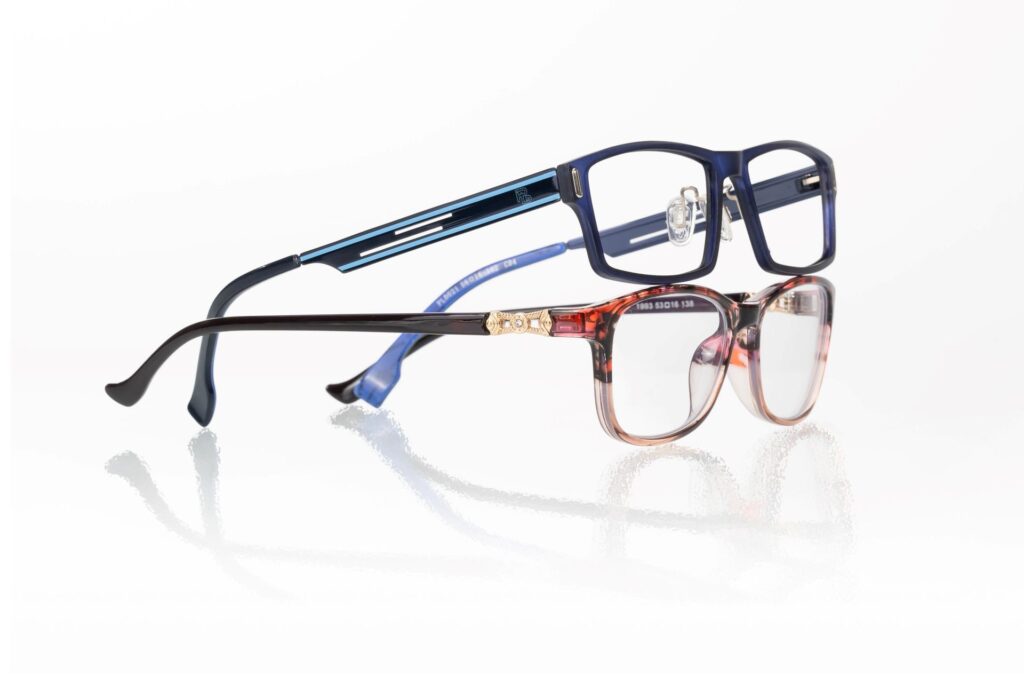
Danyang suppliers may offer prescription lenses, semi-finished lenses, finished spectacle lenses, photochromic products, bifocal and progressive designs, frames, sunglasses, cases, and related accessories. Product depth varies considerably, so a supplier listing should never substitute for a current catalog and technical quotation.
Ask whether the business produces the item itself, purchases it from another local factory, or combines products from several sources. That distinction affects traceability, customization, sample control, and the person responsible when a defect is found.
How lens factories, frame makers, and trading companies differ
A lens factory generally focuses on optical materials, surfacing, finishing, coatings, prescription formats, and production controls. A frame maker is more concerned with materials, molds, hinges, assembly, plating or coating, polishing, and fit. A trading company may coordinate several categories and communicate efficiently, but it may not own the production line for every item it quotes.
The right choice depends on your order. A direct factory relationship can be useful for repeat specifications and technical control, while a capable trading company may simplify a mixed order involving frames, cases, packaging, and several factories. In either case, request the actual manufacturing address, the commercial entity on the invoice, and a clear explanation of subcontracting.
When to source directly from a Danyang optical lens factory
Direct sourcing is most attractive when your volume, technical requirements, and reorder plans justify a closer production relationship. It may also help when you need unusual indices, defined coating stacks, custom packaging, or a stable prescription-lens program. The phrase clear ownership of specifications captures the main advantage: the supplier should know precisely what was approved and what must be repeated.
Before committing, confirm communication in writing, sample approval procedures, production lead times, inspection access, and the remedy for nonconforming goods. Direct does not automatically mean safer or lower-cost; accountability, documentation, and production consistency matter more than the label on the supplier profile.
2. Choose the right optical lenses for your market
Lens selection should begin with the customer and prescription use case, not with the most impressive catalog description. Material, index, lens design, coatings, tint, and packaging all influence price, comfort, appearance, and market compliance. Write the requirement in measurable terms so a supplier cannot interpret a general request differently from your team.
Consider the destination market early, particularly if the lenses will be sold as finished prescription eyewear. Your buyer may need specific labeling, test reports, technical files, or declarations, and those requirements can affect both supplier selection and the production timeline.

Common lens materials and index options
Common options include mineral glass and several resin or polymer materials, with index choices such as 1.499, 1.56, 1.59, 1.60, 1.61, 1.67, 1.70, 1.80, and 1.90 appearing in supplier catalogs. Availability, optical performance, impact characteristics, weight, and price differ by material and manufacturer. Do not treat the index alone as a complete product definition.
Request the exact material designation, refractive index, Abbe value where relevant, recommended prescription range, center and edge thickness assumptions, and test documentation. A supplier may quote an index while silently changing the base material or thickness design unless those details are specified.
Single-vision, bifocal, and progressive lens specifications
Single-vision lenses correct one principal distance, while bifocal lenses provide two viewing zones and progressive lenses provide a gradual transition between distances. Each category requires different measurements and verification. A progressive order should identify corridor or design requirements, fitting references, engraving or marking expectations, and the prescription data format.
For bifocals, specify the segment style and placement. For all prescription lenses, confirm sphere, cylinder, axis, addition, prism where applicable, pupillary distance, fitting height, diameter, base curve, and edge or center thickness requirements. A simple spreadsheet with one row per SKU can prevent costly interpretation errors.
Coatings, tints, photochromic features, and blue-light filters
Coatings can include hard coatings, anti-reflective layers, hydrophobic finishes, and other treatments offered by the supplier. Tints should be described by color, density, gradient, and sample reference rather than by a broad phrase such as “fashion tint.” Photochromic products require clear activation, color, fade-back, and testing expectations because performance depends on the product formulation and test conditions.
Blue-light filtering should also be defined technically. Ask for the wavelength range, transmission information, visible color effect, and supporting documentation. Compare a coated sample with the approved reference under consistent lighting before placing a larger order.
Prescription accuracy, tolerances, and quality documentation
Accuracy is controlled through the prescription input, production process, measurement equipment, and inspection method. Agree on tolerances for sphere, cylinder, axis, addition, prism, optical center, diameter, and coating appearance before production. The supplier should state which standard or internal procedure is used and provide a sample inspection report.
Keep the approved prescription file, reference samples, test results, and revision history together. This is also the appropriate place to review data privacy information if your workflow involves transmitting personally identifiable prescription data or customer records across borders.
Matching lens features to customer needs and price points
A useful range often has a clear entry option, a practical mid-tier option, and a premium option with defined reasons for the price difference. The decision should reflect prescription complexity, weight, impact needs, appearance, coating durability, and expected retail positioning rather than a long list of loosely described features.
Test the range with representative prescriptions and frame shapes. If you sell several markets, confirm whether the same lens specification and documentation can be used in each destination; local requirements may differ even when the physical product appears identical.
3. Source glasses frames and build a suitable product range
Frames determine much of the customer’s fit, comfort, and visual impression, while also affecting packing volume and breakage risk. A balanced range needs more than attractive photographs: it should cover usable sizes, reliable construction, sensible color choices, and a repeatable supply plan. Treat the collection as a system of SKUs rather than a series of isolated samples.
Ask suppliers for material declarations, size markings, hinge details, plating or coating information, and packaging options. Your specification should also explain how logos, model numbers, and retail labels are applied.
Acetate, TR90, stainless steel, titanium, and other frame materials
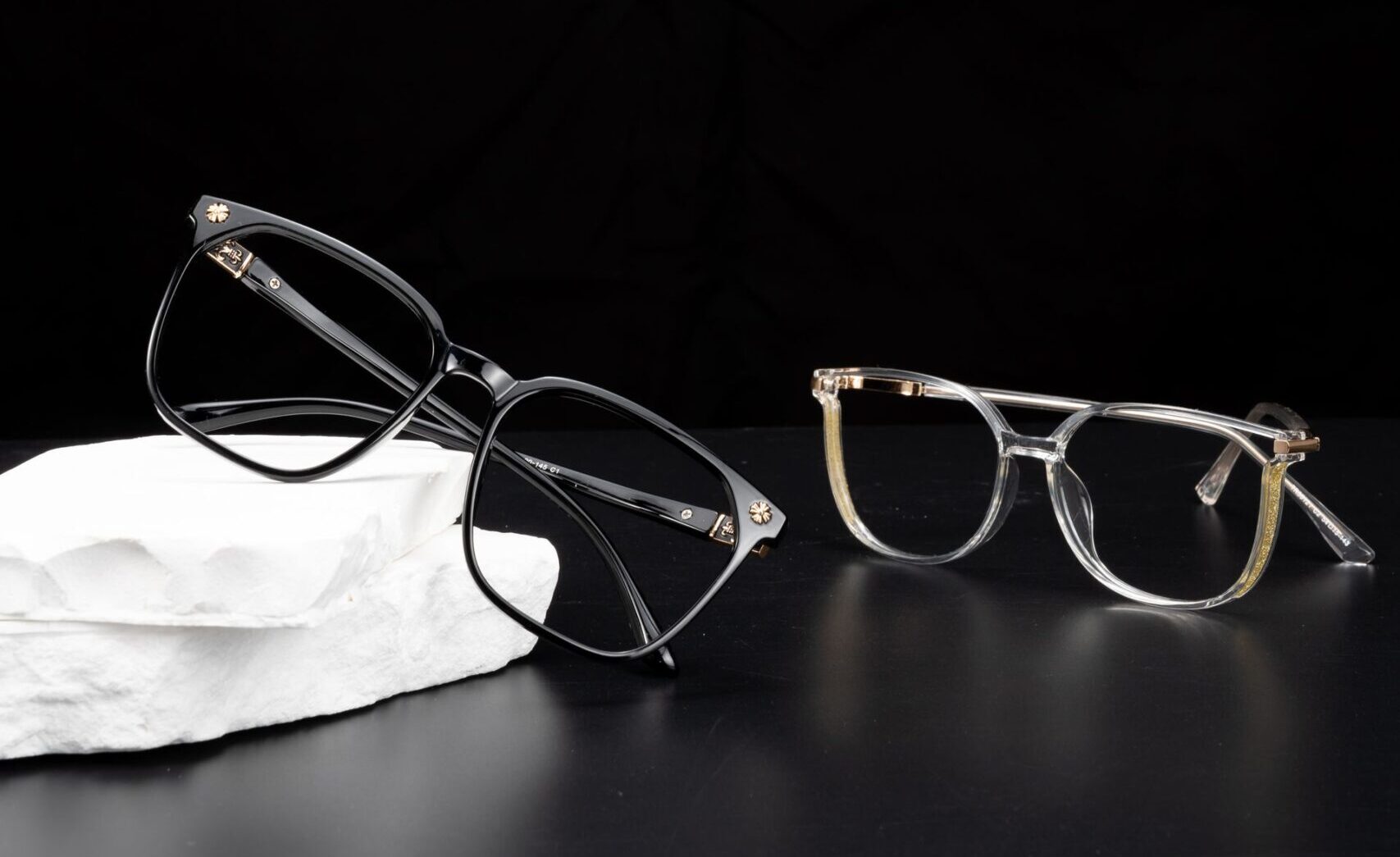
Acetate is valued for its appearance, color depth, and machinability, while TR90 and similar thermoplastic materials are often selected for lightness and flexibility. Stainless steel can support slim constructions, and titanium may be chosen for low weight and corrosion resistance, though grade and construction must be verified. Other plastics, alloys, and combinations may suit particular price points.
Do not rely on material names alone. Request the specific grade, thickness, component material, and any restricted-substance documentation required for your destination. A frame described as titanium, for example, may contain several different materials across the front, temples, hinges, and nose-pad assembly.
Evaluating frame construction, hinges, finishing, and comfort
Inspect symmetry, temple alignment, bridge shape, screw seating, hinge movement, welds, polishing, edge finishing, and surface consistency. Try samples on several face shapes and check whether the frame remains comfortable after adjustment. A visually attractive frame that is difficult to adjust or repeatedly loses screws will create avoidable after-sale work.
Use photographs and measurements in the approval record. Note acceptable variations in color and hand finishing, but define defects that require rejection, such as cracks, exposed sharp edges, uneven plating, warped fronts, or hinges that bind.
Private-label designs, stock collections, and custom molds
Stock collections can shorten development and reduce tooling costs, while private-label work gives you more control over colors, markings, packaging, and model identity. Custom molds may be appropriate for a differentiated range, but they add tooling, approval, and ownership questions. Confirm who owns the mold, where it is stored, and what happens if production stops.
For every route, request a complete quotation. Separate frame cost from mold charges, logo setup, packaging, sample fees, and any minimums by color or size. Protect original drawings and brand files through a written agreement appropriate to the transaction.
Size grading, colorways, packaging, and branding requirements
Define eye size, bridge width, temple length, total width, lens shape, and tolerance. Then list each colorway by code, finish, and reference sample. Packaging should identify the frame model, size, color, barcode or SKU, country-of-origin information where required, and any care instructions.
Premium presentation may be part of the commercial strategy, but it must be costed and tested. Guidance on luxury printed packaging can help frame the discussion around materials, finishes, and the unboxing experience without losing sight of protection and labeling.
Balancing style trends with repeat-order potential
Trend-led shapes can attract attention, but a durable assortment also needs silhouettes customers can reorder. Review sales data by size, color, material, and return reason rather than selecting only by seasonal photographs. Ask whether the supplier can repeat the same color and component combination six or twelve months later.
Keep the first range focused enough to support forecasting. A smaller group of well-specified models is easier to inspect, photograph, replenish, and explain to retailers than a broad assortment with uncertain construction and inconsistent availability.
4. Evaluate and verify Danyang eyewear suppliers
Supplier evaluation is a commercial investigation, not simply a search for the lowest quotation. Confirm the company behind the listing, the production location, the products it actually makes, and the people responsible for export communication. A short, evidence-based supplier list is more useful than dozens of unverified contacts.
Where possible, compare the same specification across several suppliers. Differences in price may reflect material, coating, packaging, tooling, inspection, freight terms, or whether the quotation comes from a factory or intermediary.

Finding manufacturers through factories, trade platforms, and referrals
Use trade platforms, local referrals, exhibitions, and direct factory outreach to build an initial list. Search results can reveal useful product vocabulary, but they do not prove manufacturing capability. Ask each contact to identify its legal entity, factory address, product categories, and export contact.
A referral is a starting point rather than a guarantee. Verify that the referred business can make your exact lens or frame specification, not merely a neighboring product. The broader China suppliers archive provides additional context for comparing supplier networks and import workflows.
Reviewing licenses, certifications, export experience, and capacity
Request the business license, relevant certifications, test reports, export references, and a description of production capacity. Check that company names and addresses are consistent across documents, invoices, bank details, and samples. Ask how capacity changes during peak periods and whether any processes are subcontracted.
For regulated eyewear, establish which technical documents apply to your destination and whether the supplier can provide current versions. Do not accept a certificate without checking its scope, issuing body, dates, and relationship to the quoted product.
Comparing factory-direct prices with trading company quotes
A factory-direct quote may offer closer technical communication, while a trading company may combine products or handle coordination across several workshops. Compare like with like: material, index, coating, accessories, packaging, tolerances, inspection, Incoterm, and payment terms should all be visible.
Ask whether the trading company adds a service fee, margin, or consolidation charge, and ask who bears responsibility for defects. A higher quote can be reasonable if it includes useful coordination, but the service and accountability should be explicit.
Requesting samples, factory audits, and production references
Order samples that represent the real production process, including the intended material, logo, coating, packaging, and size. Compare them against drawings and measurement records rather than approving a sample based only on appearance. If the order is significant, arrange a factory audit or use an independent inspection provider.
Production references can clarify communication, repeatability, and export handling, but contact them respectfully and do not treat one customer’s experience as a universal result. Record what was verified, by whom, and on what date.
Using a supplier scorecard for quality, communication, and lead time
A scorecard makes subjective impressions easier to compare. Give each supplier a consistent rating for technical fit, documentation, sample quality, response time, production capacity, inspection cooperation, commercial terms, and lead-time reliability.
Keep evidence beside each score. A supplier that answers quickly but cannot provide production records should not receive the same rating as one that responds more slowly yet supplies complete, verifiable documentation.
5. Plan pricing, samples, and production orders
The commercial plan should connect product specifications with quantity, cash flow, and replenishment. Start by separating one-time costs from recurring costs, then model several order sizes. This prevents a low unit price from obscuring tooling, packaging, inspection, inland transport, or slow-moving inventory.
Set approval gates before money is committed: supplier qualification, sample approval, pre-production confirmation, inspection, and shipment release. Each gate should have an owner and a written record.
Calculating minimum order quantities and tiered pricing
Ask whether the MOQ applies per model, color, size, prescription range, coating, or total order. A quoted tier may require a much larger commitment than your initial test order, and mixed-SKU rules can materially change the unit cost. Request a price ladder that shows quantity breaks and all assumptions.
Model expected sell-through and reorder timing rather than buying solely to reach a discount. If an MOQ creates too much inventory, the apparent unit saving may be outweighed by storage, markdowns, or obsolete packaging.
Comparing sample costs, tooling fees, and customization charges
Sample charges may cover materials, machining, coating, shipping, or engineering time. Custom frames can also involve mold development, revisions, and minimums by color. Obtain an itemized quotation and confirm whether approved sample costs or tooling fees are credited against production.
Keep a record of every revision. A small change to a bridge, hinge, logo, lens shape, or packaging insert can affect both price and lead time, so the final commercial document must identify the version being manufactured.
Creating a clear lens and frame specification sheet
A specification sheet should be readable by purchasing, quality control, the supplier, and the freight team. Include product codes, materials, dimensions, tolerances, colors, coatings, prescription fields, packaging, labeling, carton details, and approved reference images.
Use controlled revisions and require written confirmation when a field changes. For mixed orders, assign a unique SKU to every combination that affects inspection or customs description.
Setting inspection standards and acceptable defect limits
Inspection standards should distinguish critical, major, and minor defects where appropriate. Define the sample size, measurement tools, lighting conditions, cosmetic acceptance level, and the action required when a result falls outside tolerance.
Avoid vague language such as “good quality.” State measurable limits for optical power, axis, center position, scratches, coating marks, frame symmetry, hinge operation, logo placement, carton strength, and quantity accuracy. The supplier should sign off on the standard before production.
Negotiating payment terms, lead times, and reorder conditions
Payment terms should identify the deposit, balance trigger, inspection rights, and documents required before release. Lead time should be expressed from a defined event, such as deposit receipt or final sample approval, and should distinguish production from freight transit.
Also discuss reorder pricing, material availability, replacement policy, mold storage, and notice periods for discontinued components. These details matter more after the first successful order, when consistency becomes the central commercial concern.
6. Manage import logistics from Danyang to your destination
Eyewear logistics involves more than booking transport. The shipment must be collected, counted, measured, packed, documented, exported, cleared, and delivered while preserving the approved product condition. Route selection should reflect volume, urgency, cargo value, destination, documentation, and tolerance for schedule changes.
A forwarder can help coordinate supplier pickup, consolidation, export handling, freight, paperwork, customs support, and final delivery, but the importer remains responsible for providing accurate commercial and product information. Share details early enough for the route and quote to be based on real cargo.
Selecting air freight, sea freight, rail, or courier shipping
Courier and air freight suit urgent or smaller shipments, while sea freight often fits larger consignments when transit time can be planned around vessel schedules. Rail may be relevant on suitable lanes, and road transport can support regional movement or cross-border legs. The correct choice depends on the full route, not only the first quoted rate.
Compare chargeable weight, volumetric weight, handling, consolidation, insurance, cutoff dates, customs requirements, and delivery scope. The China shipping archive provides broader guidance on freight modes, consolidation, customs assistance, and shipment planning.
Preparing invoices, packing lists, certificates, and customs data
The commercial invoice should describe the goods consistently with the packing list, purchase order, and customs declaration. Include accurate quantities, values, currency, seller and buyer details, carton information, country of origin, and a product description that supports classification. Certificates and test documents should match the actual models and materials.
Prescription data may require additional care because it can contain personal information. Keep product records and customer records separate where possible, and transmit only what the supplier and compliance process genuinely require.
Choosing Incoterms and understanding landed cost
Incoterms allocate defined responsibilities between buyer and seller, but they do not replace a complete cost model. Compare EXW, FOB, CIF, DAP, or DDP only after confirming which charges, documents, customs steps, and delivery obligations are included.
Landed cost can include product price, tooling, packaging, inspection, pickup, export fees, freight, insurance, duties, taxes, customs brokerage, storage, and final delivery. Request an itemized quote based on carton count, dimensions, gross weight, destination, and cargo-ready date; you can also request a freight quote with those details prepared.
Protecting lenses and frames during packing and transit
Lenses should be separated from abrasive surfaces and protected from dust, moisture, pressure, and impact. Frames need individual sleeves or compartments, stable inner cartons, and outer packaging that can withstand handling. Mixed models should be labeled clearly to reduce counting and picking errors.
Approve the packing method with photographs before production release. For higher-value or fragile shipments, consider carton drop testing, moisture protection, palletization, and inspection photographs at pickup.
Planning customs clearance, duties, taxes, and delivery timelines
Confirm the likely tariff classification, importer-of-record requirements, destination labeling rules, and available customs documents before the cargo is collected. Duties and taxes depend on the destination, classification, declared value, origin, and applicable regulations. Customs inspections or carrier schedule changes can add time.
Build a timeline with separate milestones for production completion, pickup, export documentation, departure, arrival, clearance, and final delivery. This gives you a practical way to communicate delays without treating a carrier estimate as a fixed promise.
7. Reduce sourcing risks and maintain quality after shipment
Quality management continues after goods leave the factory. Compare received cartons and samples with the approval record, then track defects by model, material, supplier, and production batch. Early data helps distinguish a one-off handling issue from a recurring manufacturing problem.
A reliable replenishment strategy also depends on preserving specifications and commercial history. Store purchase orders, inspection reports, photos, carton counts, and corrective-action records where the purchasing team can find them.
Checking product compliance for the destination market
Identify the rules that apply to prescription lenses, frames, sunglasses, labeling, packaging, chemicals, and consumer product safety in the destination. Requirements may concern optical performance, impact resistance, restricted substances, claims, markings, technical files, or importer responsibilities.
Ask the supplier for documents that cover the exact product and current production version. If a report applies only to a different material, coating, or model, treat it as background evidence rather than complete compliance proof.
Avoiding common defects in lenses, frames, and packaging
Common risks include incorrect optical power, axis or pupillary positioning, coating marks, scratches, inconsistent tint, warped fronts, loose hinges, sharp edges, color mismatch, missing accessories, and crushed cartons. The defect list should be tied to your inspection standard and illustrated with photographs where possible.
Review returns and complaints by SKU. A small defect rate in a high-volume model may deserve faster corrective action than a larger percentage in a low-volume test item, particularly if the defect affects safety, fit, or regulatory compliance.
Using pre-shipment inspections and shipment release controls
A pre-shipment inspection should confirm quantity, workmanship, measurements, labeling, packaging, and any product-specific tests before the balance is released. Use an agreed sampling plan and make the inspection report part of the shipment file.
Do not release cargo solely because the production deadline has arrived. If a report identifies a serious issue, require rework, replacement, a documented concession, or a new inspection before shipment, depending on the agreed contract terms.
Managing warranty claims, replacements, and corrective actions
Create a standard claim process that records the SKU, batch, defect description, photographs, customer impact, and requested remedy. Separate transport damage from production defects because the responsible party and evidence may differ.
Agree on response times, replacement quantities, credit procedures, and freight responsibility before the first order. Corrective action should identify the root cause and the prevention step, not merely replace the affected pieces.
Building a long-term supplier and replenishment strategy
Long-term sourcing works best when the supplier can repeat the approved specification and communicate changes before production. Review lead time, defect trends, documentation quality, price changes, component availability, and responsiveness at regular intervals.
Maintain a qualified backup source for important models, but do not move production without a new sample and comparison inspection. Stable relationships are valuable, yet independent verification should remain part of the process.
Plan Your Shipment With Care
When you are ready to move eyewear from Danyang, prepare the supplier address, carton count, dimensions, gross weight, destination, cargo-ready date, and preferred mode. Kunpeng Freight coordinates supplier pickup, cargo inspection and consolidation, export handling, freight options, import paperwork assistance, customs documentation support, and final delivery coordination. Contact the team with the details available so the route and quotation can be assessed against the actual shipment.
Conclusion
Sourcing eyewear from Danyang can work well when product requirements, supplier responsibility, inspection standards, and landed-cost planning are treated as one connected process. Define the lenses and frames precisely, verify who is producing them, approve representative samples, and release cargo only after the agreed checks are complete. Careful documentation and practical freight planning then give you a stronger basis for repeat orders and fewer surprises at destination.
Frequently Asked Questions
Is Danyang suitable for small eyewear orders?
It can be, depending on the supplier, product type, customization level, and MOQ. Trading companies or stock collections may offer more flexibility than a factory developing a new mold or specialized prescription range.
How should I compare two Danyang lens quotations?
Compare the exact material, index, lens design, coating, prescription tolerances, packaging, quantity, sample terms, Incoterm, payment terms, and inspection provisions. A lower unit price is not meaningful if the specifications differ.
What information should a lens specification sheet include?
Include product codes, lens design, material, index, coating, tint or photochromic requirements, prescription fields, diameter, thickness assumptions, tolerances, markings, packaging, and the approved revision date.
Should I buy frames directly from a factory?
Direct factory sourcing may suit repeatable volumes or custom development, while a trading company may simplify mixed orders. The key questions are who makes the product, who controls the specification, and who handles defects.
Which shipping method is best for eyewear imports?
Courier, air, sea, rail, and road options each involve different cost, speed, capacity, and documentation trade-offs. Choose after reviewing cargo dimensions, urgency, destination, value, and customs requirements.
How can I reduce damage during eyewear transport?
Use individual protection, compartmentalized inner cartons, stable outer packaging, clear model labels, and pickup photographs. For fragile or valuable shipments, add stronger cartons, palletization, moisture protection, or additional inspection.
What should I do if received eyewear fails inspection?
Separate affected goods, photograph and record the defect, compare it with the agreed standard, and notify the supplier promptly. Decide whether rework, replacement, credit, or a documented concession is appropriate under the purchase terms.